
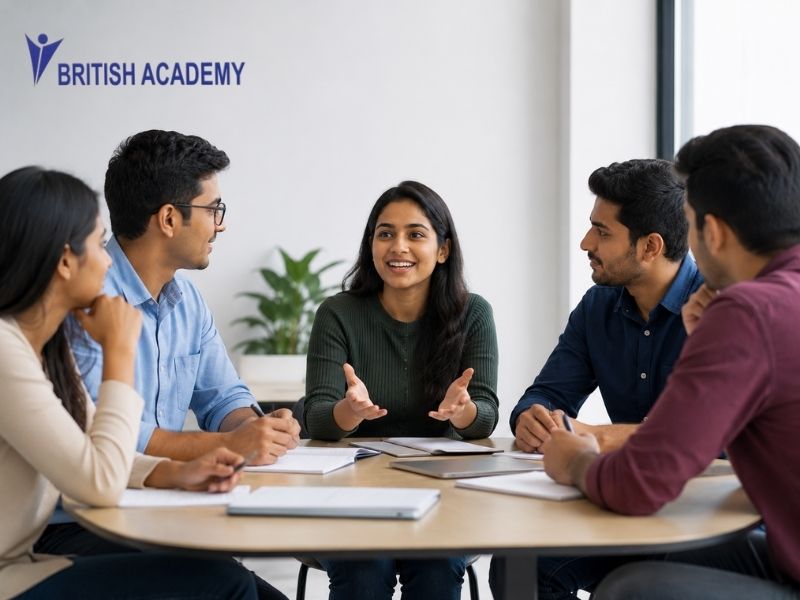
Ever realize why, in a group chat, some students will talk quite assuredly even though their peers are still figuring out what they want to say? This is a common case among students. Knowing the substance of a subject is one side of it, but the ability to talk about it with confidence to others is another.
Group discussions are topics that can be extremely helpful to students for practicing talking, getting more confidence, and also developing good ways of sharing opinions with others. Be it a classroom debate, a university speech, an interview training session, or a communication skills workshop, discussions among groups teach students how to listen, think, and respond effectively.
A student who is desirous of mastering English speaking and communication skills may rely on a reputed English Language School in Delhi, where students are exposed to practical speaking activities that help to make them comfortable and so ready for communication with others.
Having an engaging group discussion goes far beyond the capacity of yelling or convincing others that you are right. It simply means exchanging ideas, accepting others’ opinions, and leading a constructive discussion. It can be compared to playing cricket; a member of one team cannot win a match every single time. Everybody has to get involved.
What Is a Group Discussion?
A group discussion is a structured conversation where a group of people share their opinions, knowledge, and ideas about a particular topic. Schools, colleges, and organisations use discussions to understand how participants think and communicate.
During a group discussion, students are expected to:
- Present their ideas clearly
- Listen carefully to others
- Respect different opinions
- Give logical explanations
- Work together as a team
In school education and higher education, group discussions are becoming a useful part of classroom learning because they encourage students to participate actively instead of only listening.
A student who regularly participates in discussions often becomes more comfortable with public speaking and expressing opinions.
Why Are Group Discussions Important for Students?
Group discussions are not only useful for exams or interviews. They prepare students for real situations where sharing ideas and working with others becomes necessary.
Improve Communication Skills
Communication is not only about speaking English correctly. It is also about explaining your thoughts in a way that others can understand.
Through regular discussions, students learn how to organise their ideas, choose better words, and develop effective communication habits.
Build Confidence and Self-Confidence
Many students have good ideas but hesitate to speak because they worry about making mistakes. Regular practice slowly removes this fear.
The more students participate, the more comfortable they become while speaking in front of others.
Develop Critical Thinking
A good discussion makes students think beyond simple answers. They learn to analyse situations, compare opinions, and create better arguments.
These skills improve problem-solving, decision-making, and logical reasoning.
Encourage Teamwork and Collaboration
A group discussion teaches students that every opinion matters. They learn how to cooperate with classmates and understand different perspectives.
This collaborative learning approach is useful throughout student life and future careers.
Best Group Discussion Topics for Students with Answers
Choosing the right topic makes a discussion interesting and meaningful. Here are some group discussion topics for students with answers that students can practice.
1. Should Technology Be Used More in Education?
Answer:
The world of learning has changed with the advent of technology. Information is more readily available in digital classrooms and through online resources and educational videos.
Technology should, however, be a tool for learning and not the whole learning experience. Now, teachers and class interactions and discussion still have a significant role, as students learn best by communicating and collaborating with others.
The ideal solution is to strike a balance between technology and traditional learning methods.
2. Is Social Media Good or Bad for Students?
Answer:
Social media has both advantages and disadvantages. It allows students to discover educational content, connect with others, and share ideas.
At the same time, spending too much time on social platforms can affect focus and productivity.
Students should learn responsible usage and use social media as a learning tool instead of letting it control their daily routine.
3. Should Schools Teach Practical Skills?
Answer:
Yes, schools should focus on practical skills along with academic subjects. Skills like communication, teamwork, financial awareness, and leadership help students handle real-life situations.
Education should prepare students not only for exams but also for future challenges.
4. Online Learning vs Classroom Learning: Which Is Better?
Answer:
Both learning methods have their own benefits. Online learning provides flexibility, while classroom learning offers direct interaction with teachers and classmates.
A balanced combination of both can create better learning opportunities. Students can use online resources while still enjoying face-to-face discussions and peer learning.
5. Is English Important for Career Growth?
Answer:
English is widely used in education and professional environments. Good English communication can help students express ideas clearly and connect with more people.
Learning the English language does not mean replacing any other language. It simply adds another valuable skill.
Students looking for structured guidance can explore courses from the best English-speaking institute to improve vocabulary, pronunciation, and speaking confidence.
Unique Group Discussion Topics for Students
Apart from common topics, students should also practice some unique group discussion topics for students that encourage creativity and deeper thinking.
1. Can Artificial Intelligence Replace Human Creativity?
Answer:
Artificial Intelligence can complete many tasks quickly, but human creativity, emotions, and imagination remain unique. AI can support people, but human ideas and decision-making are still necessary.
2. Is Success More Important Than Happiness?
Answer:
Success and happiness both matter. Achieving goals feels rewarding, but personal relationships, health, and peace of mind also contribute to a successful life.
A balanced life often creates long-term satisfaction.
3. Should Students Learn Financial Education?
Answer:
Financial knowledge helps students understand saving, planning, and responsible spending. Basic financial education can prepare young people for practical decisions in the future.
These are some interesting group discussion topics because they encourage students to share opinions instead of giving only textbook answers.
Easy Group Discussion Topics for Beginners
Students who are new to discussions should begin with simple topics. These easy group discussion topics help beginners gain confidence.
Some examples include:
- Importance of Reading Books
- Benefits of Exercise
- My Favourite Teacher
- Importance of Time Management
- Mobile Phones: Advantages and Disadvantages
- Importance of a Clean Environment
Simple topics allow students to focus on speaking skills rather than worrying about difficult information.
Tips to Perform Better in a Group Discussion
A good participant does not need to speak continuously. The goal is to add value to the conversation.
Listen Before Sharing Your Opinion
Active listening helps you understand what others are saying. It also allows you to give better responses.
Support Your Ideas With Examples
A simple example can make your point clearer and more convincing.
Respect Other Opinions
A discussion works when everyone gets a chance to speak. Disagreeing politely shows maturity and leadership skills.
Practice Regularly
Confidence comes with practice. Students who participate in discussions regularly improve their speaking ability naturally.
Common Mistakes Students Should Avoid
Many students lose confidence because of small mistakes. Avoid these common problems:
- Speaking too quickly
- Interrupting others
- Memorizing answers without understanding
- Staying silent throughout the discussion
- Using unclear points
Remember, a group discussion is a learning activity, not a perfection test.
Improve Group Discussion Skills Through English Practice
Strong language skills make conversations easier. Students who improve vocabulary, pronunciation, and spoken English usually feel more confident while sharing their thoughts.
The British Academy focuses on practical communication development through activities that encourage speaking practice and confidence-building. With the right guidance, students can improve their public speaking, conversation skills, and overall communication.
Students searching for group discussion topics for students in English can use these examples for regular practice. A professional english language school can also help learners improve their language learning journey through structured training.
The Best English Speaking Institute in Najafgarh can provide students with opportunities to practise conversations, presentations, and real-life speaking situations.
Final Thoughts: Better Discussions Create Better Communicators
In group discussions, students are provided the opportunity to learn, share and develop with others. Practice sessions may be made more interesting for students by the appropriate choice of the GD topics and the learning of skills that are relevant in the field of education and careers.
It does not happen overnight for a student to become a confident speaker. Regular practice, patience and a willingness to share ideas are required.
By doing their part and with the support of educational websites such as the British Academy, students can enhance their communication skills, confidence, and capacity to actively engage in conversations.
Learn how to join the British Academy today to enhance your spoken English, public speaking and communication skills. Through our hands-on approach to learning, students will learn to engage in real, natural conversations, develop self-confidence, and become more proficient speakers. Improve your communication skills with the help of the experts and some practice.